
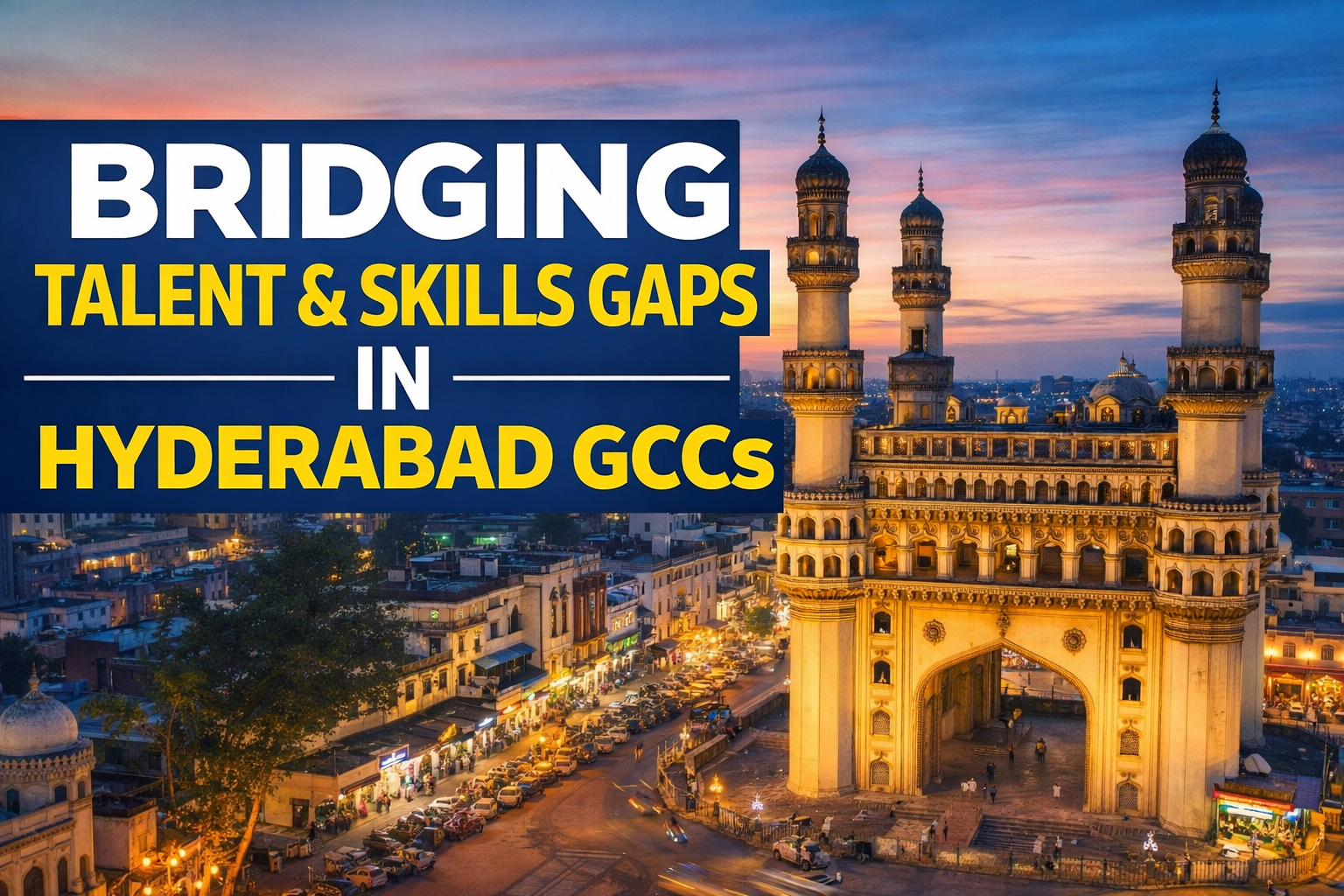
One of the most persistent challenges across India’s GCC ecosystem, including GCCS in Hyderabad, is the widening gap between demand and supply of specialized talent. Skills in AI, data analytics, machine learning, cloud, cybersecurity, and leadership roles are in short supply compared to hiring needs.
Studies point to a 41% gap in AI and data skills, while over half of GCCs struggle with retention. Costs for niche talent keep rising, and Hyderabad is feeling this pressure sharply, especially in AI/ML hiring. As a result, companies are moving away from volume hiring and focusing on sharper, high-value talent acquisition.
Global corporations are accelerating Hyderabad’s GCC expansion, with players like Google, Microsoft, Amazon, Meta, Apple, and JPMorgan scaling aggressively, while entrants such as L’Oréal and The Hartford add fresh momentum. These centers are chasing high-end, cross-domain capabilities across pharma, life sciences, BFSI, and deep tech. The speed of growth is widening talent gaps, pushing the need for sharper skilling, tighter academia alignment, and stronger government-backed workforce development.
Strategies to bridge the talent and skills gaps in Hyderabad GCCs
Here’s how government (Telangana + Central), GCC leaders, academia, Nasscom/CII, and ecosystem players can address Hyderabad’s GCC talent crunch, especially the persistent ~41% gap in AI, data, and analytics as of 2026. These are grounded in recent insights from Quess Corp, India Skills Report, Nasscom, TASK/TAIH initiatives, and active MoUs shaping the ecosystem.
Q1: What’s the biggest talent bottleneck for Hyderabad GCCs right now?
A: Specialized roles in AI, ML, GenAI, data analytics, cloud, cybersecurity, and leadership remain the toughest to fill. Reports highlight a ~41% gap in AI/data skills. Hiring cycles stretch beyond 45 days for over half the roles, while attrition and talent poaching intensify as GCCs shift toward innovation-led mandates. With 350+ GCCs in Hyderabad, competition for the same elite talent pool (IIIT-H, IIT-H, etc.) is intense.
Q2: How can the Telangana government step up on skilling?
A: Scale TASK aggressively, targeting 50k–100k+ learners in AI and digital domains. Strengthen TAIH and fast-track the AI University. Expand global partnerships (like Pearson-style credentialing and AI healthcare collaborations). Offer incentives, land support, and subsidies for GCC-linked training programs. Extend skilling beyond urban clusters through rural and SHG-driven AI initiatives.
Q3: What should GCC companies do differently?
A: Move from passive hiring to active capability building. Co-create curricula with institutions (IIIT-H, CBIT, Vardhaman), run joint labs, embed live projects, and start internships early. Invest heavily in internal reskilling for AI-native capabilities. Adopt “hire-build-scale” models—prioritize potential, develop skills internally, and reward depth over volume. Use AI-led hiring smartly, but double down on retention through growth paths and ownership roles.
Q4: How can academia-industry collaboration improve?
A: Focus on outcome-driven partnerships. Integrate real GCC problem statements into coursework, set up joint R&D labs, and convert internships into full-time pipelines. Make hands-on, experiential learning mandatory. Use NEP 2020 to roll out modular credentials in GenAI, MLOps, and emerging domains. Industry events and summits should translate into signed, execution-ready partnerships.
Q5: What policy support can unlock faster progress?
A: Introduce tax incentives for corporate skilling investments and promote skills-first hiring frameworks. Build portable digital skill passports under Skill India. Create GCC-focused talent funds tied to capability development. Encourage sector-specific talent pools via Nasscom/CII to reduce hiring friction and enable shared pipelines in niche areas like AI governance and DevSecOps.
Q6: How do we improve retention and reduce talent churn?
A: Build a stronger ecosystem around continuous learning, career mobility, and workplace flexibility. Track skill depth and long-term capability instead of just headcount. Use predictive analytics for attrition and empower local leadership. Hyderabad already has lifestyle advantages—pair that with meaningful, high-impact roles to retain top talent.
Q7: Is this momentum real in 2026?
A: Momentum is real and building. Telangana’s AI push, TASK expansion, and global collaborations are gaining traction, while GCCs are shifting from scale-driven hiring to capability-driven growth. If execution stays tight and stakeholders work in sync, Hyderabad can turn this talent gap into a long-term advantage and anchor India’s $100B GCC ambition by 2030.
For more updates on GCCs in Hyderabad, Follow Cyril Solomon – Consultant For GCCs in Hyderabad, Founder of Happening Hyderabad, a top voice on GCCs in Hyderabad, also visit many articles on the Happening Hyderabad portal.